 RN
RN
 From Images to Video: How AI Porn Generation Is Moving Beyond Static Content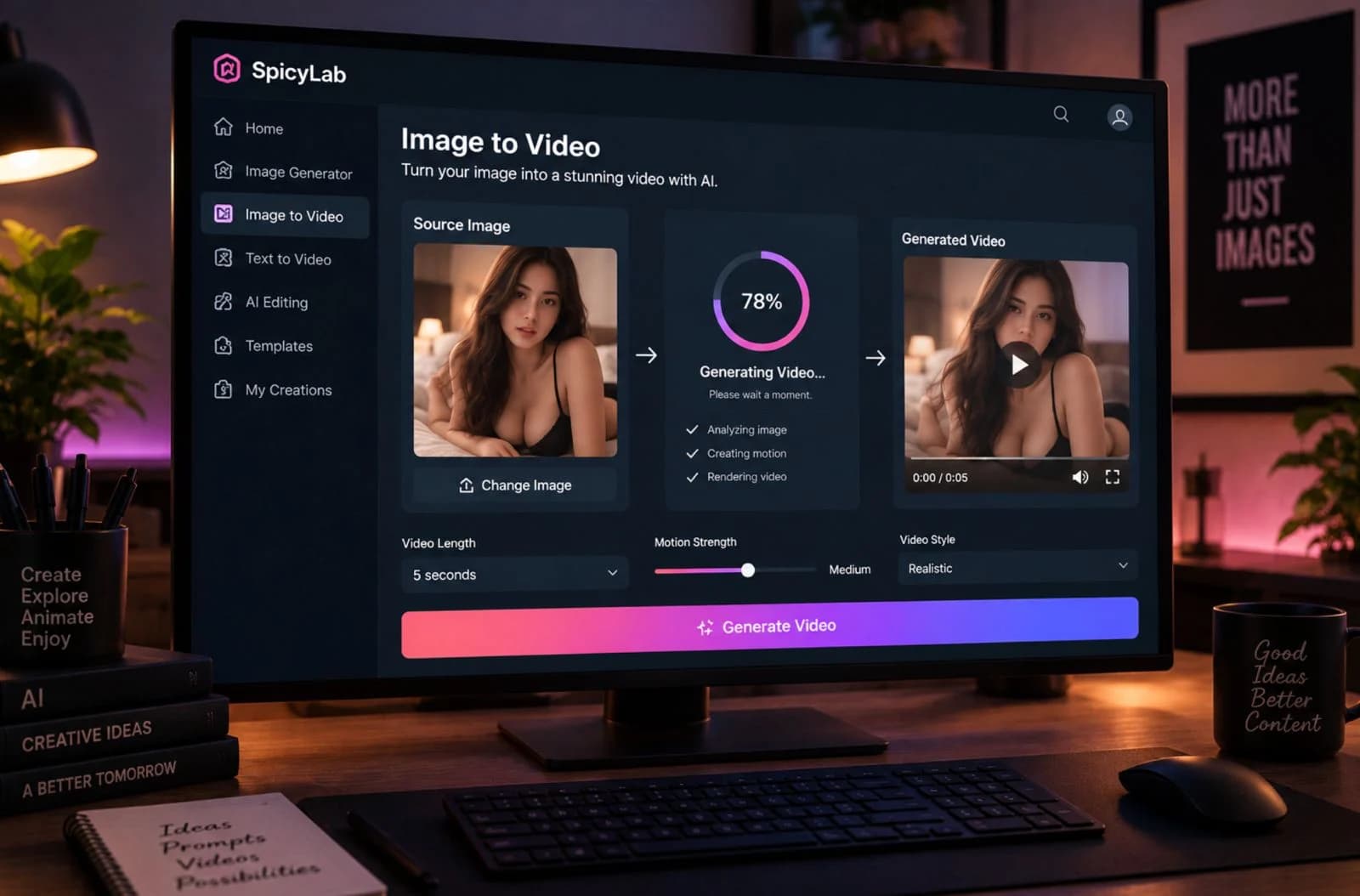
SponsoredTHAPORNDUDE was paid to publish this partner article. It is not an independent review or editorial endorsement.
For the first wave of generative AI, the image was everything. Type a prompt, wait a little, and get a picture that did not exist before. For adult AI, that lowered the technical barrier to creating fictional characters and scenes and made personalisation much easier than it had been with conventional digital art.
But a static image has an obvious limitation: it does not move. As generative AI shifts toward video, the question is changing from “Can AI create the image I have in mind?” to “Can I turn this image into a convincing video?”
That sounds like a small step. Technically, it is not. Generating a sequence of frames while keeping a character, appearance, and environment intact is far harder than producing one good still. Temporal consistency, appearance drift, structural warping, and identity preservation remain active research problems.
The image is becoming a starting point
Image-to-video starts with a reference image and attempts to introduce movement while preserving important visual characteristics. That changes the creative process. Someone can spend time getting a fictional character right first - face, hair, clothing, body position, lighting, environment, and visual style - then animate that work rather than rebuilding it from scratch with a text-only prompt.
For adult AI, where personalisation is a major part of the appeal, that continuity matters. The useful workflow is increasingly simple to describe: create the character first, animate the character second.
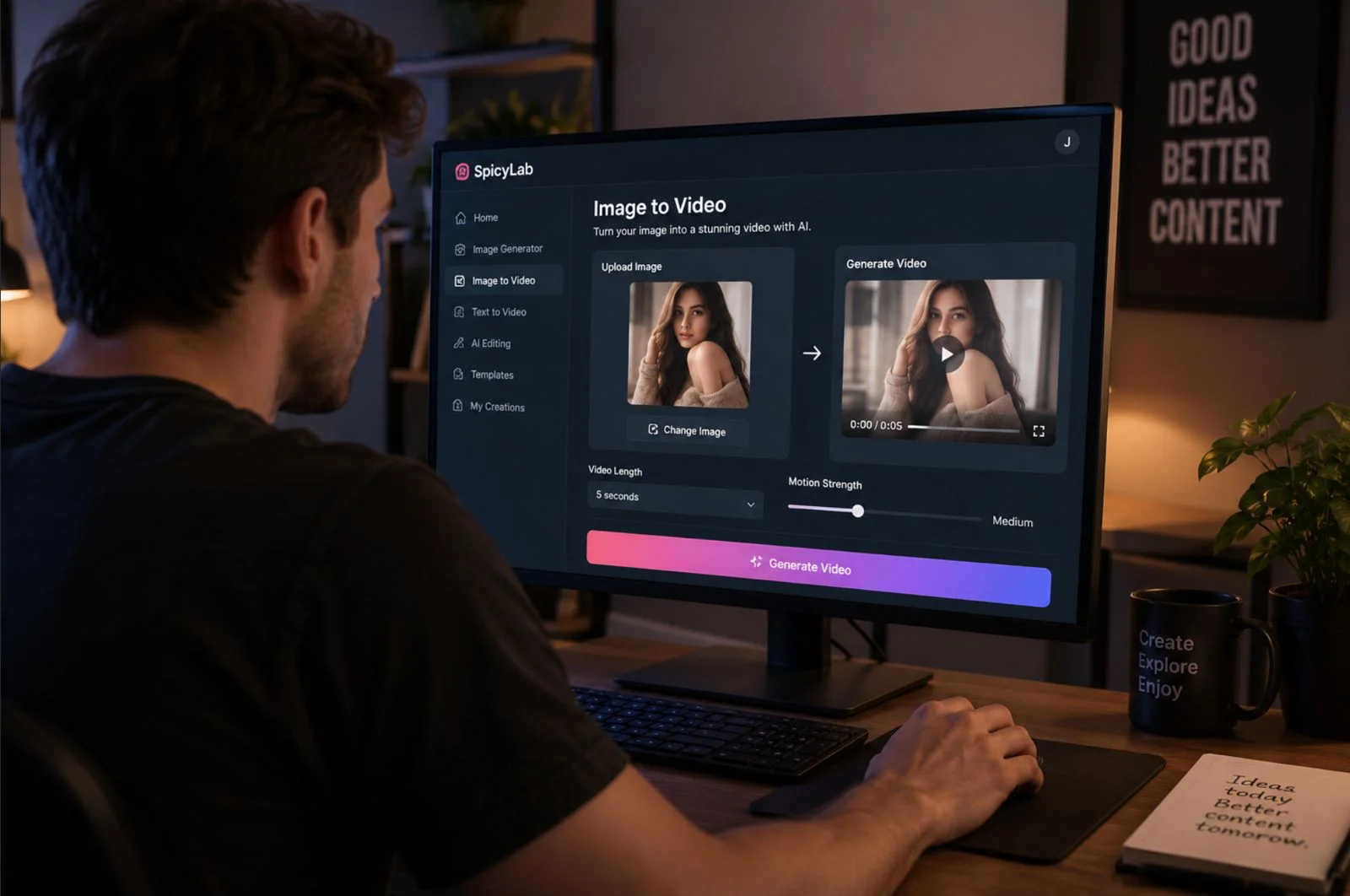
Image-to-video and text-to-video are not the same
It is tempting to group all AI video generators together, but image-to-video and text-to-video solve different creative problems. With text-to-video, the prompt carries most of the instruction. The model has to interpret characters, setting, composition, and movement. That is useful when you are starting with an idea.
With image-to-video, much of the visual starting point already exists. The problem becomes introducing believable motion without losing what made the source image work. That is useful when you are starting with a character. Neither approach is inherently better; they offer different levels of control.
- Develop a concept.
- Generate or edit a source image.
- Select the strongest image.
- Generate video, review it, then refine.
This is why platforms increasingly combine image creation, editing, image-to-video, and text-to-video in the same environment. Tools such as SpicyLab bring AI image editing, image-to-video, and text-to-video generation into a single workflow. The image generator creates the visual identity. The editing tool refines it. The video model attempts to make it move.
Why source images matter more than people expect
One lesson users learn quickly is that the source image matters a lot. Ambiguous poses, unusual anatomy, obstructed subjects, extreme perspectives, and complicated compositions all give a model more opportunities to make mistakes. A beautiful still is not automatically a useful animation source.
A hand partly hidden behind an object does not need to make complete anatomical sense in a still image. Once that hand moves, it does. The same holds for limbs, clothing, hair, backgrounds, and interactions between subjects. Do not judge a source only by how good it looks; judge it by how clearly a video model can understand it.
The biggest problem is still consistency
Watch a good AI-generated clip once and it can be impressive. Watch it several times and you may notice a facial feature changing, fingers shifting shape, clothing behaving strangely, or a background subtly transforming. This is temporal inconsistency.
An image generator makes one decision. A video generator has to make compatible decisions across many frames. That is why short clips can often be more convincing than ambitious long sequences: the longer the model must maintain a scene, the more opportunities it has to drift.
Motion is harder than it looks
Generating movement is not the same as generating good movement. People are highly sensitive to motion that feels wrong. A slightly strange detail in a still may pass unnoticed, but unnatural movement is obvious immediately.
A convincing clip needs individual frames that look good, a recognisable character, plausible geometry, and transitions that make sense. Constrained motion and templates can be useful because giving a model a specific job is often more reliable than asking it to invent a complex sequence from a vague instruction.
AI video is not replacing images
Static AI imagery is not going anywhere. Images are faster to generate, easier to review and edit, and less computationally demanding. They are also useful as the foundation for video. The relationship is changing from image or video to image, then video.
A strong static image can become a character sheet, a keyframe, or a creative anchor. Once a creator is happy with the character and composition, video becomes an extra layer rather than a replacement.
Consent matters even more with video
Generating fictional adult characters is one thing. Using an identifiable real person's likeness without permission is another. As tools become better at preserving identity and animating source images, consent, provenance, age, and lawful use become more important - not less.
Being technically able to upload an image does not automatically give someone the right to use it. Platforms need clear rules around prohibited material, real-person likenesses, age, consent, and unlawful content. Those are not side issues for adult generative AI; they will help determine which platforms remain credible as the category matures.
From generating pictures to creating scenes
The interesting development is not simply that AI video will get prettier. It is that creators will expect more control and consistency: the same character across multiple generations, motion that does not destroy appearance, longer clips with less drift, and tools to repair one part of a generation without starting over.
The line between image creation and video creation is likely to keep fading. Instead of separate tools, people will want a generative studio where an idea can move between text, image, editing, and video without leaving the workflow.
Adult generative AI began with a simple promise: describe an image and let a model create it. Video changes that promise. The challenge is no longer only what something looks like, but what happens next. Static images are increasingly not the finished product - they are the first frame.